Why I Still Think Like a Chef When Building Marketing Automation Systems
Marketing automation has a reputation for being too complicated. But it's just a matter of breaking it down into smaller pieces and giving it some thought. Like a good recipe. It's not just about throwing a bunch of stuff together and praying for a miracle. It's about carefully choosing each ingredient, thinking about the steps you need to take, and how you want the finished product to turn out. The same thing applies to marketing automation. If you view it as a series of connected tasks, rather than some kind of magic trick, you can actually make it work for you.
Imagine a chef navigating the kitchen with purpose and precision. It's not a free-for-all of trial and error, but rather a deliberate dance of preparation, orchestration, and timing. I don't dance but anyone will definitely feel the flow of a good service once you repeat it countless times. Mise-en-place is king. We learn that from day one. Each dish is a mix of ingredients that don't even come from the same sources. Some from land, and some from water. Strangers when they are still alive but best friends when they come together in the kitchen. Working together to create something that is magical. Food that nourishes life. I sound like a big brand/company. Haha.
Marketing works the same way. Swap the kitchen for a CRM and the logic holds. Show up consistently, fix what's off, repeat until it just runs. That's really all it is.
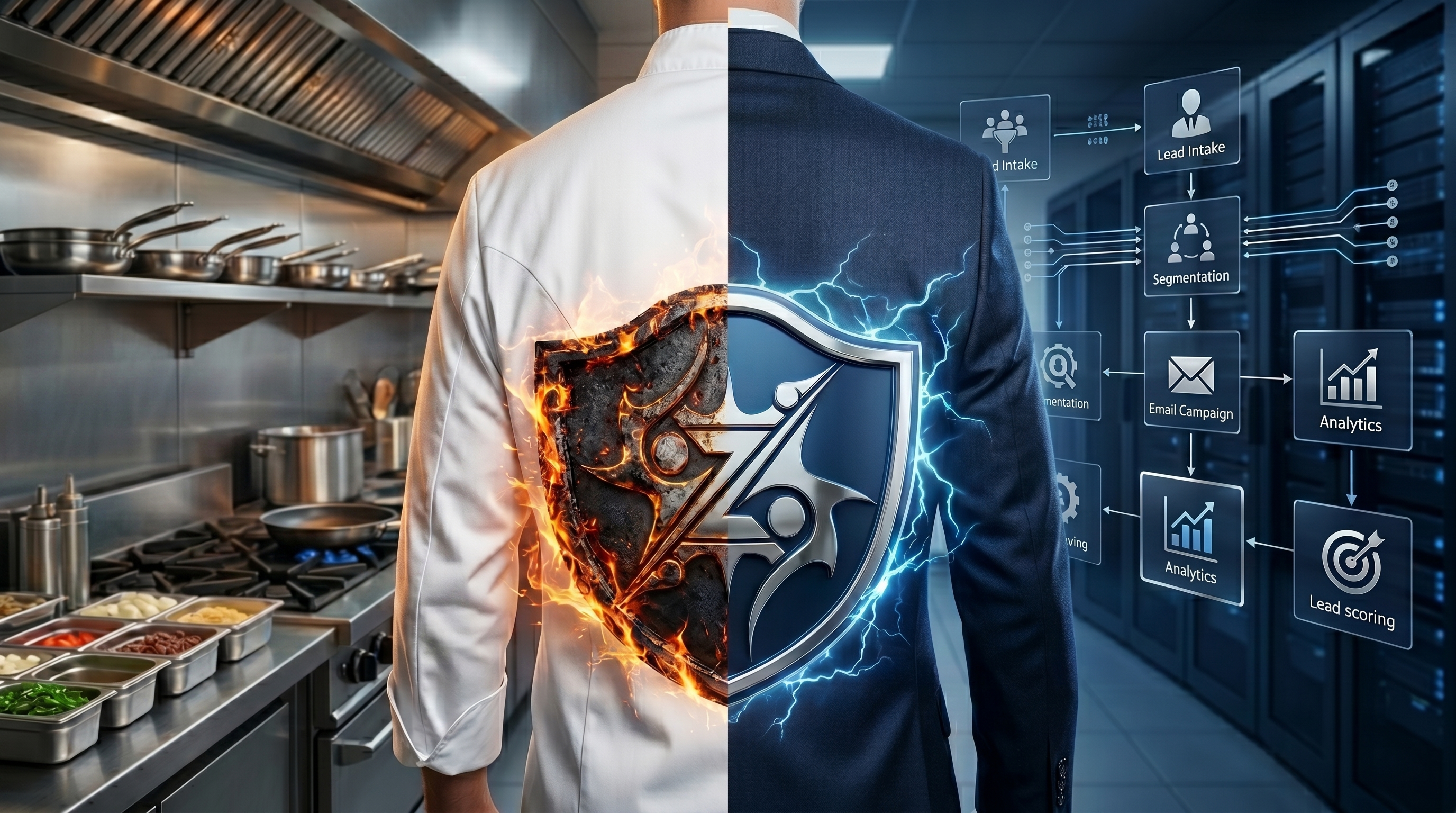
There's this thing I learned a while back that I still find useful today. A chef only needs to master 3 things. It's all about Time, Temperature, and Technique. Let me describe it to make it easier to imagine and apply it to marketing.
Time is basically when things happen. How long do i simmer? When do i season? When do I add the rest of the ingredients? In marketing that's all about timing too. When do you send a message? When do you follow up? When do you re-engage someone? If your timing is off, even good messages can come across as off-putting.
Temperature is basically how hot or cold do you need your food to be to achieve the perfect texture and taste. In marketing this is how people respond to your campaign. Some people are super cold, they don't know you yet. Others are warm, they're interested but still unsure. And then there are those who are hot, they're ready to act. It feels like Black Friday sale to them. You can't treat them all the same, you have to read the room, and send the right signals.
Technique is which cooking method you use. You need good culinary foundations for this one. This means repetition until you master cooking or you lose your fingers or sanity. Whichever comes first. Once you have the proper techniques, cooking is easier and then you can start with the "art" side of culinary arts. In marketing this is the system itself, the behind-the-scenes stuff that makes everything run smoothly. That's your automation, your workflows, your CRM setup, your triggers. All the things that take the manual effort out of marketing.
When all three of these come together, everything just feels right, but when they don't, it's like trying to force a square peg into a round hole.
Every recipe starts with ingredients. Not really applicable for me since I start with a sudden burst of idea, or some call it inpiration, and only then do i check for availability of ingredients. But most standard recipes start with ingredients. In marketing, that means your traffic sources, your landing pages, your CRM contacts, your messages, and your offers. It's not rocket science, just the raw materials you work with.
Before I go into a long tangent about cooking, let's focus on marketing for now. Must check myself that this is about marketing. I'll talk about what my mentor in culinary arts always reminds us about mise-en-place. He always says "Proper Planning Prevents Piss Poor Performance". This is always followed by some colorful expletives which he uses to show his students his love. This is my blog so... fuck you too chef! haha
Before you touch any tool, think through the whole thing first. What happens when a lead comes in? What if they ignore you? What if they actually book a call? Every "what if" needs an answer before you build. That's where automation wins — a good workflow handles all of it without you having to babysit every step.
Planning isn't extra work — it IS the work. Once the system is up, something shifts. You're not chasing leads, writing follow-ups, or booking calls manually anymore. The system does it. Your job becomes making sure the system doesn't break. That's a weird adjustment honestly. You go from doing everything to watching everything. The setup takes weeks, which sounds like a lot until you remember that a normal kitchen shift is 14 hours and nobody complains. Once it's live, you're mostly just monitoring — making sure nothing in the workflow quietly skips a step while you're not looking.
People often think marketing success is all about being busy. This may be true for a traditional marketing team. But pumping out more posts, running more campaigns, and throwing more effort at the problem is useless for automated marketing. It could just lead to more complications. That's not where the real power lies. Over time, you start to realize that the key to scaling your marketing is building systems that can run on their own, freeing up time and resources for you to focus on the big picture.
That's the core idea behind Chef to Automation - putting efficiency over just being productive. Work smart not hard. Instead of getting bogged down in the details of every campaign, you need to understand how systems work, and how to design them to get the best results. It's not about questioning every marketing strategy, but about building a system that just works. Like a well established recipe. If it works then it works.
As you get a handle on how systems behave, marketing tasks start to feel a lot more manageable. If you're looking to build your own marketing systems or automate your business, the Automation Systems and Workflow Strategy sections are a great place to start. They'll give you the foundation you need to build systems that are robust, sustainable, and actually make your life easier.