
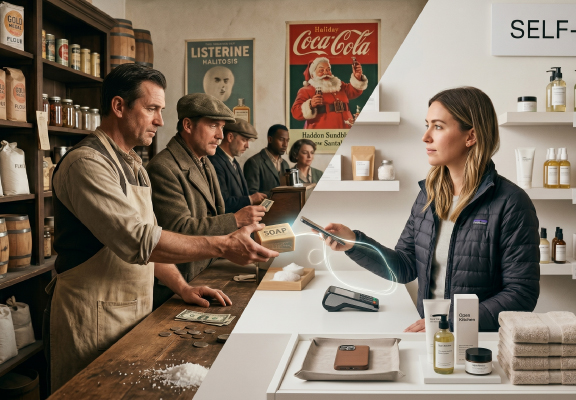
The History of the Craving: How Marketing Moved from the Stomach to the Soul
The History of the Craving: Why We Really Buy
In the professional kitchen, history is in the seasoning. You cannot make a modern sauce without knowing the mother sauces first. As a former chef turned marketing specialist, I see our shopping habits the same way. Every time you click a button today, you are following a trail blazed by your great-great-grandfather at a dusty general store.
We are going to walk through the service of history. We are going to look at the moments that rewired the human brain. We are going to see how we moved from buying for our hands to buying for our souls.
1. The Era of the Handshake (1800s)
The Priority of Survival and Substance
Imagine you are standing in the year 1826. The air is thick with the smell of horse hay, woodsmoke, and raw wool. You are walking into a local general store. There are no neon signs and no "buy one get one free" offers.
Back then, there was no marketing. There was only utility. If you needed flour, you went to the local miller. You didn't go because he had a catchy slogan. You went because he was the only one there and you knew his face. Every cent you spent was an investment in staying alive for another month.
The Psychology of the Cellar Satisfaction back then didn't come from a "dopamine hit" on a screen. It came from security. A full cellar of potatoes for the winter was the ultimate status symbol. You didn't buy boots to look cool. You bought them because if the leather cracked in January, you might lose a toe.
This was the birth of quality control. If a neighbor sold you moldy grain, he couldn't show his face at the town meeting. Trust was a physical thing you could touch. It was the weight of a handshake. The gentlemen's agreement. You put your honor on the line.
2. The Era of the Standard (Early 1900s)
The Birth of the Brand and the Invention of Shame
Now move forward to the early 1900s. Factories are humming. Steam engines are moving goods across the country. This was the birth of mass production. For the first time in human history, you could get the same quality every single time. But companies realized that "quality" wasn't enough to keep the factories running. They had to give you a reason to buy more than you needed.
The Listerine Trap This is where the "History of the Craving" gets dark. In the 1920s, a company called Listerine changed the world. They took a natural human thing like bad breath and gave it a scary, scientific name: Halitosis.
They didn't sell mouthwash. They sold a social tragedy. They ran ads showing a beautiful woman standing alone at a party. The caption said "Often a bridesmaid, never a bride." They told you that your friends were whispering about you. They invented the "itch" so they could sell you the "scratch." They moved marketing from the stomach to the ego. I think this will still be a successful campaign today as people are more competitive with plenty of competition. who wants to be a bridesmaid forever, right?
The Birth of Brand Trust This is also when we stopped buying "flour" and started buying "Gold Medal Flour." People started buying soap because it was wrapped in paper, promising it was untouched by human hands. We stopped trusting our neighbors and started trusting the machine.
The Ultimate Holiday Hijack: The Red Suit Strategy
You cannot talk about the history of the craving without looking at the masterclass taught by Coca-Cola. Before the 1930s, Santa Claus was a bit of a shapeshifter. Depending on where you lived, he might be a thin, spooky elf, or even a tall man in a green or brown suit. He was a folk legend, but he didn't have a "brand."
In 1931, Coca-Cola hired an artist named Haddon Sundblom. They didn't want a "spooky elf." They wanted someone who embodied the warmth and joy of a cold soda on a winter day. Sundblom painted Santa as a jolly, plump, grandfatherly figure and he dressed him in Coca-Cola Red.
The Psychological Link They didn't just run an ad. They hijacked a tradition. By showing Santa pausing for a Coke while delivering toys, they tied the "joy of Christmas" to the "joy of the product." They turned a beverage into a symbol of family, warmth, and the holiday spirit.
The Result Today, most people on Earth think Santa has always looked like that. Coke didn't just advertise; they re-wrote a global myth to match their brand. That is the pinnacle of move from Survival to Identity. You aren't buying a drink; you are buying the feeling of a family gathering.
3. The Dream Era (1950s to 1970s)
Aspirational Identity and the Great Diamond Lie
After World War II, the world exploded with color. This was the era of the "white picket fence." The "Dream" was for sale, and everyone wanted a piece of it. Marketing became about who you wanted to be.
The De Beers Masterclass We have to talk about the diamonds. De Beers realized that diamonds aren't actually rare. To keep the price high, they had to make sure you never sold them back. They hired an ad agency that created the slogan "A Diamond is Forever."
They tied a physical rock to the concept of eternal love. They told men that they should spend two months' salary on a ring or they didn't truly love their fiancé. It was a masterpiece of storytelling that created a "requirement" out of thin air. They didn't sell jewelry. They sold a social contract.
Keeping Up With the Joneses This was the age of Aspirational Identity. If your neighbor got a new shiny pick-up truck, you felt a "lack" in your own life. We started using "things" to talk for us. The car in the driveway told the world exactly where you sat in the social hierarchy.
4. The Skeptic Era (1980s to 1990s)
The Truth as a Weapon
By the 1980s, the "common person" got smart. We had seen enough glossy commercials to know they were mostly lies. We were tired of the "perfect" families on TV. This is when the most successful brands started using honesty as a weapon.
Think Small and Just Do It Volkswagen ran an ad that just said "Lemon" under a picture of a car. They explained that a tiny scratch on the glove compartment meant the car didn't pass their test. By admitting a small failure, they made you believe every other claim they made.
Nike did the same thing. They didn't show you a person winning a gold medal. They showed a 17-year-old kid sweating in the rain. They focused on the grit and the struggle. They stood against "laziness." They gave you a "Shared Enemy" to fight.
5. The Identity Era (2000s to 2026)
This is where the story meets the modern world. We have moved beyond selling products. We are now selling mirrors that reflect who the consumer is.
The Mirror Strategy: Spotify Wrapped Spotify hijacked the end of the year. They don't send you an ad. They give you a report on your musical soul. People share their Wrapped results to show their friends their personality. Spotify isn't just an app. It is a diary of your year.
The Emotional Hospitality: Jollibee Jollibee is the king of making people cry. Their ads focus on unrequited love, loss, and sacrifice. They don't sell fried chicken until the very end. They sell belonging. They show that they understand the human heart, and that is why people are loyal to them. They are a part of the family.
The Digital Hijack: Burger King Burger King used GPS to "detour" people. If you were near a McDonald's, their app unlocked a 1-cent Whopper. They used technology to turn a rival’s strength into a game. This is automation used to create an experience, not just a sale.
The Radical Honesty: Patagonia On Black Friday, Patagonia ran an ad that said "Don't Buy This Jacket." They told people to repair old clothes instead. By standing for the Earth we all share, they built a tribe. They didn't sell a jacket. They sold a mission.
The Cultural Garnish: Liquid Death How do you sell water to people who hate ads? You put it in a beer can and call it Liquid Death. They realized that "healthy" marketing was boring. They created a shared enemy: boring corporate brands.
Today: The "Executive Chefs" of the Economy
Millennials are now the ones holding the credit cards. They are the most time-poor generation in history. They grew up watching the world move from analog to digital, and they have a "fake radar" that is incredibly sensitive.
They value what we call "Mise en Place" in the kitchen. They want everything in its place, ready to go, with zero friction. If your product doesn't make their life simpler, they will delete your app in seconds. They trust a review from a random person on Reddit more than a 10 million dollar celebrity commercial. Because that random person is also a consumer just like them.
The 2026 Marketing Menu: The Strategy of Humanity
To win today, you have to move from "Survival" marketing to "Identity" marketing. You have to treat your customer like a guest at your table.
Step 1: The Open Kitchen Policy
In the old days, the kitchen was hidden. Today, people want to see the "mess." If you sell skincare, show the dirt on the plants. Show the laboratory. Show the real people with tired eyes bottling the product. This builds "Limbic Trust." It tells the customer that you are a human just like them.
Step 2: The Subscription Prep (Automation)
Automation should be your "sous-chef." It’s the waiter who remembers that a guest is allergic to gluten.
Example: A parent buys diapers. Your system remembers. Three weeks later, an email arrives with a one-click reorder button and a helpful tip on how to get a toddler to sleep. You aren't a salesman. You are a partner in their survival.
Step 3: The Hype Garnish (Gen Alpha)
The children of Millennials do not see ads. They see content. They don't want a 30-second TV spot. They want to see their favorite creator actually using the product in real life. If the creator likes it, the kid "needs" it.
Step 4: The Frugality Flex
In 2026, being "smart with money" is a status symbol. Don't just tell them the price. Tell them the "Cost-Per-Use." Tell them that your jacket is designed to be passed down to their younger siblings. That makes the 200 dollar price tag look like a 20 dollar a year investment. I do this math when buying "expensive" things that I use daily. They are not expensive if you break the cost down to daily cost and you use it for years.
Three Pillars of Trust
Consistency: Like a signature dish, it must be the same every time.
Authority: You must look like the "Expert Chef" of your industry.
Social Proof: Nobody eats in an empty restaurant. Reviews are the "line out the door."
The Bottom Line: We All Breathe the Same Air
Marketing today isn't about being the loudest. It is about hospitality.
We all have the same drives. We all have the same troubles. We all feel the same pain. We all belong to the same earth. Whether it was a general store in 1826 or a smartphone in 2026, we are all just looking for a way to feel like we belong.
Treat your leads like guests. Give them the truth. Make their experience effortless. Never serve them bad food. You want to be the salt in their kitchen. Invisible when it is there, but the whole meal is ruined if it is missing.