
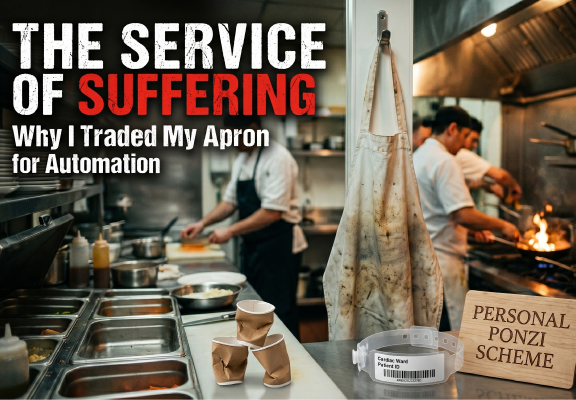
The Service of Suffering: Why I Traded My Apron for Automation
The Service of Suffering: Why Your Hustle Culture is a Kitchen Nightmare
Listen up. Close the door, put your phone face down, and stop twitching. If you can’t focus for fifteen minutes without checking a notification, you’ve already lost. This is a unique post. Something I hope not to repeat as the research into psychology is a weird rabbit hole. I triedto explain the terms used. Thank you google i guess.
In my previous life, I ran kitchens. I didn’t manage them. I ruled them. In a high end kitchen, hustle wasn’t a buzzword. It was a physical requirement for survival. If the Julienne wasn't a perfect 2mm by 2mm by 5cm matchstick, it went in the trash.
Most cooks I know love the word Julienne. They say it with a smirk, thinking it makes them sound sophisticated. But the moment they pick up a knife, their consistency is a joke. They want the glory of the technique without the discipline of the repetitions. They think the hustle is the speed of the knife, when real mastery is the consistency of the result.
Now, I’m in marketing automation. It’s cleaner, sure. But I see a different kind of rot here. It’s a sickness called Hustle Addiction, and I’m writing this because I almost died from it.
The Psychology of the Burn: The Martyrdom Complex
As a chef, I lived the nightmare. I have stood on a line for 20 hours non stop. No sitting. No bathroom breaks. Just the relentless ticket machine screaming at me like a banshee.
I thought I was a hero. I thought my ability to endure pain made me superior to the normies who wanted to go home at 5:00 PM. I was trapped in a Martyrdom Complex. This is a psychological state where you actually seek out pain because suffering makes you feel morally superior to everyone else. You aren't working for the customer anymore. You’re working to prove you can bleed more than the person next to you.
The Sunk Cost Fallacy of the 20th Hour
When you hit hour 14 and your legs feel like lead, you don't stop. You fall victim to the Sunk Cost Fallacy. This is the mental trap where you keep going simply because you’ve already put in so much effort. You feel like you can't quit now because then the last 14 hours were for nothing.
You tell yourself that the 20th hour is where the real work happens. It’s a lie. Clinically speaking, after hour 14, your brain is a malfunctioning engine. Your fine motor skills are gone, your decision making is compromised, and your Julienne looks like it was cut by a lawnmower. You aren't grinding. You are hallucinating efficiency while producing garbage.
The Personal Ponzi Scheme: Borrowing from the Future
Hustle addiction is just a Personal Ponzi Scheme. You are borrowing energy, health, and mental resources from tomorrow to pay for the busy work of today.
The Origin of the Scam
In the 1920s, Charles Ponzi became famous for a scam where he promised investors massive returns in record time. He wasn't actually generating profit. He was just using money from new investors to pay off the old ones. It looked like a massive success on the outside, but it was a house of cards. It required a constant, frantic influx of new cash to keep the lie from collapsing.
When you hustle, you are Charles Ponzi. You use caffeine, adrenaline, and missed sleep to pay off the exhaustion of yesterday. You keep the scam going until you run out of energy to trick.
The 40 Year Old Debt Collector
When I turned 40, the debt collector came for me. It wasn't a slow realization. It was a heart attack.
The Old Guard loves to tell stories of the guy who worked until he dropped as if it’s a legend. Let me tell you from the other side of the hospital bed: THERE IS NO GLORY IN A CARDIAC WARD. That heart attack was my body finally declaring bankruptcy. I realized that my 20 hour days weren't a heroic deed. They were a path of self destruction. I was serving my life on a platter to a hustle that didn't even know my name.
The Series A Fallacy: The Moving Goalpost
In the startup and marketing world, we see this in the Arrival Fallacy. This is the mistaken belief that once you reach a specific destination, like a promotion or a funding round, you will finally be happy and the stress will vanish.
Founders think if they just grind until the Series A funding, they can finally breathe. It’s a trap. For the addict, the goalpost always moves. The Series A funding isn't the finish line. It’s just a more expensive treadmill with a steeper incline. If you haven't built a system to handle the heat, the funding just gives you a bigger kitchen to burn down.
Marketing Automation: The Mise en Place of the Mind
People think automation is about doing more. They think if they automate their emails, they can spend that time doing even more work.
Wrong. Start over.
In a kitchen, we have Mise en Place. This means everything in its place. You prep your station so that when the rush comes, you are calm. You are precise. Marketing automation should be your Cognitive Mise en Place. It is meant to reduce Decision Fatigue. This is the documented decline in the quality of your choices after a long session of mental load.
The Bad Hustle: Manually checking leads like a cook trying to Julienne a crate of carrots by hand for a 500 person banquet when the food processor is sitting right there. That’s not hard work. It’s stupidity.
The Chef’s Way: Building a system that handles the grunt work so you can focus on the flavor. The strategy. The story. The things a machine can't do.
The Fear of the Quiet: Why We Can't Stop
Why do we keep swinging the knife even when we’re exhausted? Because of Experiential Avoidance. This is our frantic attempt to escape difficult thoughts or feelings by burying ourselves in activity, even when that activity causes us long term harm.
Most people hustle because they are terrified of what happens when the noise stops. In the kitchen, if it's silent, you have to hear your own thoughts. You have to face the void. The Old Guard loves the noise. The screaming, the clanging, the 2 AM emails. They love it because it drowns out the realization that they might not be okay.
How to De Tox: The New Standard
If a plate comes to my pass and the Julienne is sloppy, I don't care how hard you worked. It stays in the kitchen.
Kill the Performative Busy ness. Real work is the slow reduction of a stock. It isn't a frantic sprint. It's a controlled simmer.
Respect the Rest. A blunt knife is a dangerous knife. In the kitchen, we sharpened our blades every day. You need to sharpen your mind without a productivity podcast playing in the background.
Audit Your Output. Are you cooking for the guest or the noise? If you’re just making noise, you’re not a chef. You’re a distraction.
Final Word: The Table is Waiting
I left the kitchen because I had to. My heart literally couldn't take the lie anymore. I transitioned to marketing automation because I realized that the hustle wasn't the goal. The output was the goal.
Look at your to do list right now. If you are doing it to feel like a hero, stop. You aren't a hero for working yourself into a heart attack at 40. You’re a casualty of a bad system.
Clean your station. Take a breath. The dining room is filling up. Don't serve them your exhaustion. Serve them your best work.
Now, get back to work. But do it right this time. Also I’m not a psychologist. I did my research but I could be wrong with these fancy psychology terms.